
ISRO has successfully launched EOS-05, India's first geo-imaging satellite, into a precise sub-geosynchronous transfer orbit using a GSLV rocket. This 2,367 kg satellite, the heaviest ever carried by a GSLV, will provide real-time imagery for applications in agriculture and disaster management from an altitude of 36,000 km.

Skyroot Aerospace successfully launched India's first privately developed orbital rocket, Vikram-1, placing multiple technology demonstration payloads and commemorative items, including a postcard from Prime Minister Narendra Modi, into low Earth orbit, marking a significant entry into the global orbital launch market.

Jio Platforms Limited (JPL) believes satellite broadband services are unlikely to achieve significant scale or compete effectively on price in India's highly connected and affordable market, despite developing its own satellite constellation solutions and flagging it as a potential disruptor.

Skyroot Aerospace is set to launch the maiden test flight of its orbital-class rocket, Vikram-1, from SDSC-SHAR on July 18, marking a significant milestone for India's private sector in the global launch business.

Odisha-based Serendipity Space successfully demonstrated drug crystallisation processes on a satellite prototype in a near-space mission. This breakthrough aims to enable pharmaceutical manufacturing in low Earth orbit, leveraging microgravity to create superior drug crystal structures for enhanced solubility, stability, and effectiveness. The mission tested core technologies, including an autonomous pharmaceutical factory, and was inspired by advancements made on the International Space Station.

'The Indian private space sector is no longer a high-risk bet; it is a highly bankable, globally competitive asset class capable of easing the global small satellite launch bottleneck.'

Jio Platforms managing director Akash Ambani announced plans for Jio to develop a sovereign Low Earth Orbit (LEO) satellite constellation and partner with global providers to extend connectivity to remote areas of India, aiming to strengthen India's self-reliance in space.

'With Vikram-1, we take our biggest step yet towards a reliable, high-cadence launch programme built in India, for India and the world.'

'PowerBank-50 is now space proven, made in India, and ready for every satellite builder in the world.'

It is about proving that the agency can still deliver when the stakes are high.

Elon Musk's Starlink is in "active and productive discussions" with the Indian government, awaiting final regulatory clearance, including spectrum allocation, to launch its satellite internet services, despite media reports suggesting a freeze on approvals.

One of the most striking features in this view is the Orientale Basin, a massive impact crater about 600 miles (965 km) wide.
'It is not economical to operate GSLV-Mk II due to its cost and complexity. Future launches to be managed with LVM3.'
Astrobase Space Technologies, a Bengaluru-based startup, has unveiled 'EVEREST', India's first privately built full-flow staged combustion (FFSC) LOX-Methane rocket engine. This advanced engine, designed for reusable medium-lift launch vehicles, aims to enhance India's position in the global space economy by providing high-performance propulsion systems for future satellite deployments.

NASA's Artemis II crew offers a rare look at Earth shrinking into space and the Moon coming into view during humanity's return to deep space.
Elon Musk, CEO of SpaceX, stated that Starlink's services in India must be affordable for widespread adoption and that competition would benefit consumers, despite potentially reducing Reliance Jio's profits. He criticised Reliance Jio as a 'de facto monopoly' in India, alleging that certain business conglomerates were blocking Starlink's entry.
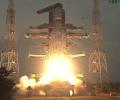
The heaviest communication satellite to be launched from the Indian soil onboard a new generation, homegrown 'Bahubali' rocket was successfully placed into the intended orbit on Sunday, the Indian Space Research Organisation said.

'... but runs with the rigour and discipline of a large enterprise.'

From selfies to science, astronauts aboard Orion document life, work and discovery during their historic Moon flyby.

Buying a mature rocket technology gives companies the designs and hardware know-how, but not necessarily the decades of engineering wisdom needed to make it work.

Chennai-based Agnikul Cosmos plans to launch a prototype AI data centre in orbit by the end of this year, aiming for commercial viability by 2027, according to co-founder Srinath Ravichandran.
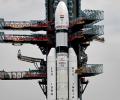
'The LVM3 rocket will orbit one Block 2 BlueBird satellite in Low Earth Orbit.'

Weighing 6,100 kg, the communication satellite would be the heaviest payload to be placed into the Low Earth Orbit (LEO) in LVM3 launch history from Indian soil.
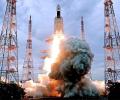
ISRO is developing a third launch pad at Shriharikota to accommodate heavier satellites and next-generation launch vehicles. The new facility will support both crewed and uncrewed missions.
NASA has announced three missions to the moon as part of efforts to establish a permanent base on the earth's natural satellite. The USD 20 billion plan includes lunar rovers and drones for experiments to help master skills to live and operate in the dangerous environment.

ISRO Chairman V Narayanan announced the development of a massive rocket capable of placing 75,000 kg payloads in low earth orbit, highlighting India's growing space capabilities and future satellite launches.
India's space regulator INSPACe has granted a license to Starlink to offer space-based internet services in the country. The authorization is valid for five years and subject to regulatory provisions and clearances.

As part of a plan to refinance debt and expand its upcoming constellation of satellites, French satellite major Eutelsat Communications will raise euro 1.35 billion, or $1.55 billion, through a reserved capital increase and a rights issue, the company announced on Friday. Bharti Enterprises' space venture, Bharti Space Ltd, will invest euro 31.4 million, or $36 million, in the capital raise.

The ISRO on Sunday scripted yet another history after its LVM3 rocket successfully placed 36 satellites of United Kingdom-based OneWeb group company into intended orbits.

A new study suggests that moons orbiting free-floating planets, with dense hydrogen atmospheres and tidal heating, could maintain liquid oceans for billions of years, potentially supporting the development of complex life.

The government has issued Letter of Intent to Starlink for satcom services, sources said on Wednesday. Starlink is a satellite internet service developed by SpaceX -- the American aerospace manufacturer and space transportation company founded in 2002 by world's richest man Elon Musk.
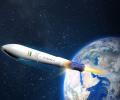
The Vikram-I rocket will fly with its maximum carrying capacity and put the satellites in a Low Earth Orbit.

The Indian Space Research Organisation on Sunday faced a blip in its plan to tap the small satellite launch vehicle market, as an anomaly in the placing of the satellites by the rocket led to deviation on its path thereby becoming 'no longer usable', Chairman S Somanath said on Sunday.
ISRO has announced plans for seven launch missions by March, including the first uncrewed mission for the Gaganyaan project and demonstrations of new satellite technologies.

The mission objective is to ensure data continuity of ocean color and wind vector data to sustain the operational applications.

ISRO said the upper stage of the Polar Satellite Launch Vehicle - C37 (PSLV-C37) re-entered the earth's atmosphere on October 6, 2024 and the impact point was the North Atlantic Ocean.

Astronaut Shubhanshu Shukla discusses the Gaganyaan mission and its potential to inspire other nations in space exploration, drawing on his experiences as an IAF test pilot and his time on the International Space Station.
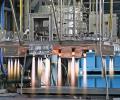
With these successful tests, ISRO has moved a step closer to India's first human spaceflight mission, Gaganyaan.

Indian astronaut Shubhanshu Shukla, currently on the ISS as part of the Axiom-4 mission, has acknowledged ISRO's efforts in ensuring his safe travel. He spoke with ISRO chairman V Narayanan about his well-being and the experiments being conducted on the ISS.

Astronaut Shubhanshu Shukla and the Axiom-4 mission crew are scheduled to return to Earth from the International Space Station on July 14, according to NASA.
